From Complexity to Clarity
How I Transform Complex Subjects into Structured Learning Journeys
An educator's perspective on transforming complex knowledge into meaningful, practical, and measurable learning experiences.
By Vijay Alagarsamy
The challenge isn't always the complexity of the subject. It's how we introduce it to learners.
A technically brilliant subject-matter expert may understand every detail of a topic. A comprehensive manual may contain everything a learner needs to know. A presentation may have hundreds of carefully prepared slides.
Yet, after going through all that information, learners may still struggle to answer a simple question:
"Now that I understand the concept, what am I supposed to do with it?"
Throughout my journey in engineering education, curriculum development, enterprise technology, and technical training, I have encountered subjects that demand considerable cognitive effort from learners.
Sometimes, the difficulty lies in unfamiliar terminology. Sometimes, it is the relationship between interconnected concepts. And sometimes, learners understand the individual components but struggle to apply them in a real-world situation.
These experiences have shaped a principle that guides my work:
The purpose of curriculum design is not to make every subject appear simple. It is to make even complex subjects learnable.
To me, creating a meaningful learning experience is much more than organizing information into modules or converting technical documents into presentation slides.
It involves understanding the learner, identifying the capability to be developed, carefully structuring the knowledge, and creating opportunities to practise and demonstrate that capability.
Here is the approach I follow:
1. Start with the Outcome, Not the Content
One of the most important decisions I make happens before I begin developing any learning material.
I ask myself:
What should the learner be able to do differently after completing this learning experience?
This question changes the direction of the entire design process.
Instead of starting with a list of topics or product features, I begin with three considerations.
The business or performance need: What problem should this learning initiative help address?
The learner profile: Who are the learners? What is their experience, what do they already understand, and what are they expected to accomplish?
The evidence of success: What observable knowledge, decision, or performance would demonstrate meaningful progress?
For example, consider a course introducing document automation.
An objective such as "Understand document automation" provides a broad direction but leaves considerable room for interpretation.
A more specific objective could be:
"Given a sample document-processing scenario, identify when manual review may be necessary and explain the reason for that decision."
The second statement gives me a clearer basis for selecting content, designing activities, and determining how learning should be evaluated.
It also helps distinguish between information that is interesting and information that is essential for the desired performance.
My principle: I design backwards from performance, not forwards from information.
2. Break Complexity into Meaningful Learning Blocks
Complexity is not always caused by the amount of information.
Often, it results from too many new concepts being introduced together, unclear relationships between topics, or missing prerequisite knowledge.
When I study an unfamiliar or technically demanding subject, I first try to understand its underlying structure.
I look for four elements:
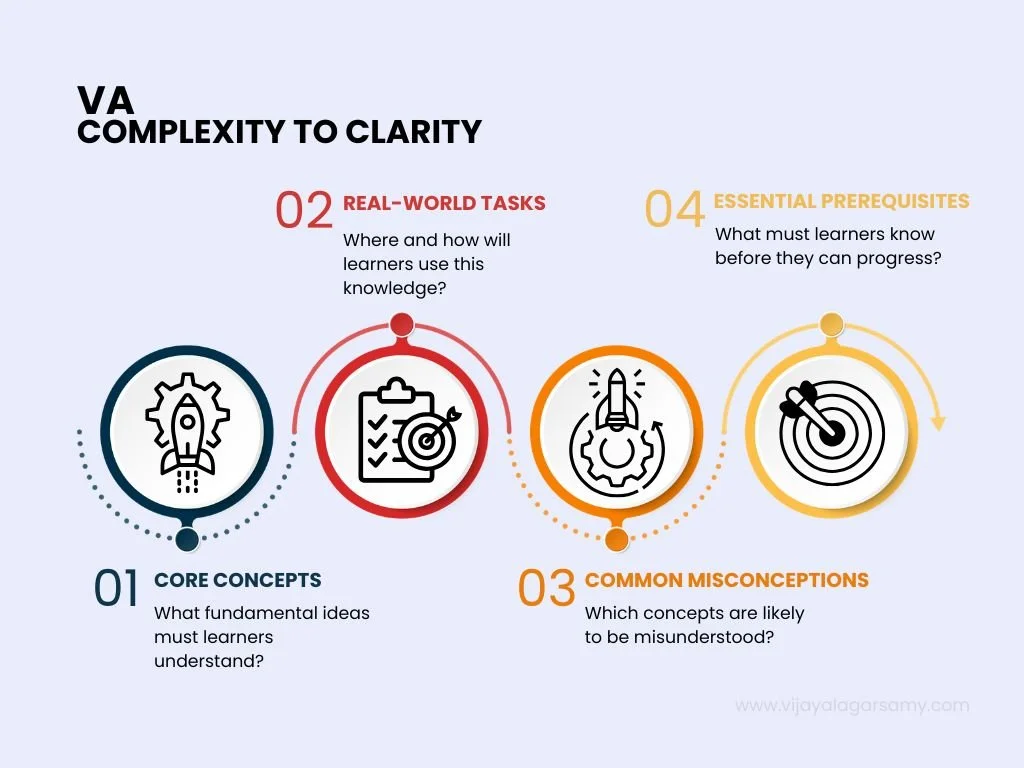
I then examine how these elements connect.
For instance, learners exploring an automated document-processing workflow may encounter document classification, information extraction, validation, exception handling, and human review.
Presenting all these capabilities simultaneously could make the learning experience unnecessarily demanding.
Instead, I would first establish the purpose of the workflow, introduce the individual components, explain their relationships, and gradually connect them through practical examples.
This is where concept mapping, content analysis, and careful instructional sequencing become valuable.
I also distinguish between what learners must know, what they should understand, and what they can access later through a reference resource or job aid.
Not every detail deserves equal instructional attention.
Complexity becomes more manageable when knowledge is mapped with clarity.
3. Sequence the Learning Journey — From Awareness to Application
Once I have identified the important learning components, the next challenge is sequencing them.
Even accurate and well-written content can become difficult to learn when introduced in the wrong order.
I generally think about progression through five connected stages.
Foundation
Establish the purpose of the subject, essential terminology, and fundamental concepts.
The aim is to create a reliable starting point.
Guided Understanding
Help learners make connections between concepts through structured explanations, comparisons, and examples.
At this stage, the emphasis moves from recognizing information to understanding relationships.
Demonstration
Show learners how concepts operate in a meaningful context.
Demonstrations help bridge the gap between conceptual understanding and actual performance.
Practice
Provide opportunities for learners to apply knowledge, make decisions, explore scenarios, and receive feedback.
Application
Encourage learners to work through increasingly realistic situations with greater independence.
This progression is not necessarily a rigid sequence. Experienced learners may enter at different points, and some complex topics require moving back and forth between explanation and practice.
However, the principle remains important:
A meaningful learning journey should gradually move learners from awareness towards confident action.
Where Bloom's Taxonomy Fits
I use Bloom's Taxonomy as a useful lens for examining the cognitive demands of learning objectives and assessments.
Recognizing a concept, explaining how it works, applying it to a problem, and evaluating a decision require different kinds of thinking.
Consequently, they should not all be assessed in the same way.
For example, a foundational module might emphasize remembering and understanding. A configuration-oriented module could require applying and analyzing. A quality-focused learning experience may involve evaluating decisions against defined criteria.
Bloom's Taxonomy helps me consider the level of cognitive engagement required, while the actual learner task determines the most appropriate instructional method.
4. Match the Learning Method to the Moment
Not every concept needs a slide deck. Not every learning objective needs a video.
One of the most important aspects of instructional design is choosing the right learning method for the intended outcome.
I generally evaluate the need through four questions.
Should I explain it?
Short explanations, illustrations, animations, and conceptual models can help establish understanding.
Should I demonstrate it?
Product walkthroughs, instructor demonstrations, and guided examples are useful when learners need to understand a workflow or procedure.
Should learners practise it?
Case studies, exercises, simulations, decision-making activities, and discussions provide opportunities to apply knowledge.
Will learners need support afterwards?
Checklists, reference guides, troubleshooting resources, and job aids can support performance beyond the formal learning experience.
This is particularly important when designing learning for working professionals.
Learners may have limited time, substantial prior experience, and an immediate need to apply their knowledge.
In instructor-led training, the challenge is often not how much an instructor can explain, but how meaningfully participants can engage with and use the concepts.
In digital learning, the challenge is to provide sufficient guidance, interaction, and feedback without making the experience unnecessarily lengthy.
In technical customer education, a well-designed troubleshooting guide may be more useful at the point of need than asking someone to repeat an entire course.
The goal is not to use every available instructional technology.
The goal is to select the method that best serves the learning outcome.
5. Make Learning Measurable
A learning journey should provide a meaningful way to determine whether learners are progressing.
For me, this means thinking about evaluation during the design stage, not after the course has been completed.
I consider three connected levels of evidence.
Learning Objectives
What knowledge or capability should the learner demonstrate?
Objectives should be sufficiently clear to guide both instruction and evaluation.
Checks for Understanding
What evidence during the learning experience will help identify misconceptions or incomplete understanding?
These might include questions, short activities, guided reflections, or formative feedback.
Applied Performance
How can learners demonstrate that they are able to use their knowledge in an appropriate context?
Depending on the learning goal, this could involve completing a workflow, interpreting information, selecting an appropriate response, or evaluating a solution.
Importantly, completing a course does not automatically demonstrate workplace competence.
Similarly, a positive satisfaction rating tells us something about the learning experience, but does not necessarily prove improved job performance.
Where possible, I prefer to examine how learning translates into application through appropriate activities, practical assessments, follow-up feedback, or other ethically and operationally suitable measures.
A well-designed learning experience should not only communicate knowledge; it should create opportunities to demonstrate its use.
6. Turn Complexity into Confidence
Ultimately, I want learners to experience a meaningful transformation.
A complex subject should gradually become a clear set of connected concepts.
Those concepts should become a structured learning pathway.
That pathway should create opportunities for meaningful practice.
And through appropriate practice and feedback, learners should develop the capability and confidence to act.
I think of the journey as:
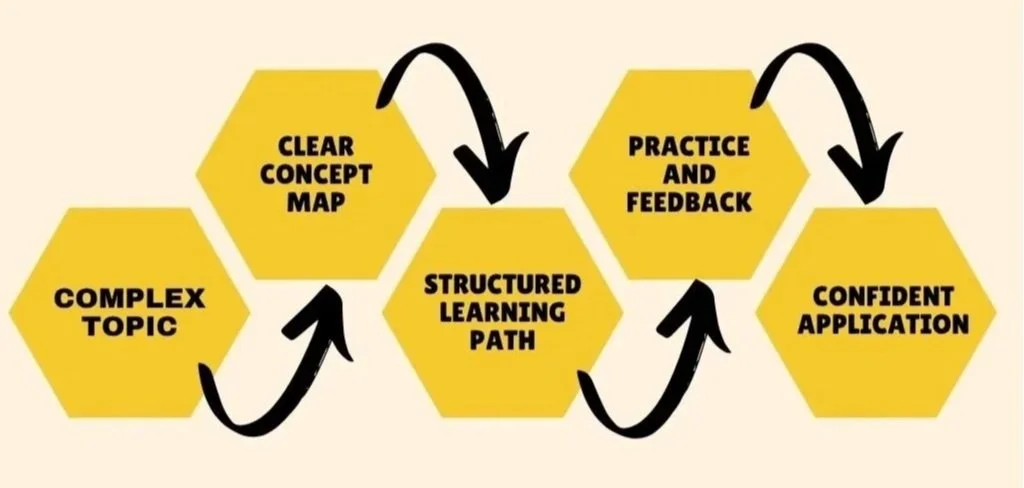
This transformation is rarely achieved by simplifying language alone.
It requires carefully designed instructional decisions: what to introduce, what to defer, what to demonstrate, what to practise, and what to evaluate.
It also requires recognizing that different learners may need different degrees of support.
My goal is not to eliminate the intellectual challenge of learning. Challenge is often essential to developing deeper understanding.
My goal is to make the challenge purposeful, achievable, and relevant.
The Instructional Design Thinking Behind My Approach
Frameworks such as ADDIE and Bloom's Taxonomy play an important role in my instructional design practice.
ADDIE helps me examine the learning problem across five connected activities: Analysis, Design, Development, Implementation, and Evaluation.
Bloom's Taxonomy helps me examine what learners are expected to understand, apply, analyze, or evaluate.
Neither is simply a checklist to be completed.
I see them as frameworks that support deliberate, evidence-informed decisions.
My engineering background also influences how I approach learning design.
Engineering teaches us to examine systems, understand dependencies, identify constraints, and validate solutions.
Education teaches us to understand people, build connections, support practice, and recognize that learning is a process rather than an event.
Bringing these perspectives together has shaped the way I design curriculum.
I do not begin by asking how many modules a course should contain.
I begin by asking what capability needs to be developed and how the learning experience can support its development.
From Design Philosophy to Practice
These principles also inform my work in enterprise customer education, where technical products often contain interconnected concepts, configurations, workflows, and operational considerations.
One example is the design of a progressive customer education pathway for enterprise document automation.
The broader design challenge involved organizing foundational concepts, practical configuration knowledge, and quality and maintenance considerations into a coherent learning journey.
The experience reinforced the importance of connecting learning architecture with the capabilities learners are expected to develop.
I discuss the high-level design thinking behind this work in my separate portfolio case study:
Case Study 01 — Designing a Customer Education Ecosystem
The case study uses independently recreated illustrations to explain the design approach without reproducing confidential organizational learning materials.
Final Reflection: From Complexity to Clarity
Whether I am designing a technical course, structuring an instructor-led learning program, or transforming unfamiliar information into a meaningful educational experience, I return to the same essential questions:
What matters most to the learner?
What knowledge and capability are truly required?
What is the most logical way to develop them?
What experiences will help learners apply their understanding?
And how will we recognize meaningful progress?
The answers may change depending on the subject, audience, and learning environment.
But the philosophy remains consistent.
Good curriculum design organizes knowledge. Meaningful learning experience design helps people turn that knowledge into capability.
And that, to me, is the purpose of transforming complexity into clarity.
My LinkedIn Post: https://lnkd.in/p/gztNhmXq
Vijay Alagarsamy
Learning Experience Designer | Curriculum Architect | Customer Education Strategist
Explore My Case Studies | View My Portfolio