The Birthday I Couldn't Buy
How a Kayak, the Chozhas, the Stars and a Mangrove Forest Gave My Son Something No Gift Ever Could
"Childhood is not measured by the number of gifts we give our children, but by the number of worlds we help them discover."
There are birthdays that disappear into family photo albums.
A cake.
A few candles.
Some balloons.
A handful of smiling faces.
And then there are birthdays that quietly become part of a child's character.
Those are the birthdays I have always wanted for my children.
For the last few years, I have followed a small tradition… one that means far more to me than buying the latest toy or planning an extravagant celebration. Every birthday, I try to introduce my children to something they have never experienced before.
A new sport.
A new landscape.
A new challenge.
A new way of looking at the world.
Because I have come to believe that childhood is built less by the things we own and more by the experiences we live.
A toy eventually finds its place inside a cupboard.
An experience quietly finds its place inside character.
This year, with my son's birthday approaching on 12 July, I wanted to give him another memory to carry into adulthood.
The plan was simple.
Take him for stargazing and then kayaking through the mangroves.
What I didn't realise then was that the weekend would become so much more.
It would become a journey through the waterways of the Chozha region.
A conversation about one of India's greatest maritime civilizations.
An evening beneath some of the oldest light in the universe.
A birthday celebrated among strangers who, within a few hours, would no longer feel like strangers.
And somewhere in between all of that... It became another reminder that the greatest adventures in life are rarely the ones we plan.
A Journey That Began Long Before the Kayak
The destination was MangroveBay Eco Camp, nestled near the beautiful mangroves of Pichavaram in Tamil Nadu.
But kayaking wasn't the only reason we were travelling there.
The event had been organised by Starvoirs, a wonderful community that brings together astronomy, history and nature in ways that few organisations do. This was, in fact, my second event with them, and I already knew from experience that whenever they announced something, it was worth attending.
This particular weekend promised something truly special.
A stargazing session. Camping beside the mangroves. And an interactive discussion with historian and author Anirudh Kanisetti on the Chozha Empire – their maritime trade, overseas expansion, archaeological evidence and, perhaps most fascinating of all, the role astronomy played in helping them navigate the seas centuries before satellites and GPS.
For someone who loves history, science and the outdoors, it was impossible to resist.
Sometimes Lunch Has to Wait
On the morning of 11 July, my son and I packed our bags, loaded our trusty Tata Nexon, and started driving towards Chidambaram.
Road trips with children are interesting.
You may be the one driving.
But somehow, they become your favourite travelling companions.
Our conversations wandered from school and books to the places we crossed, the vehicles overtaking us, and the villages slowly replacing the city's concrete landscape.
The original plan was straightforward.
Reach Chidambaram - Have lunch - Arrive at the campsite around 2 PM – Relax - Settle into the surroundings - Allow ourselves to absorb the place before the event began at 2:30.
Like many well-made plans...
Reality had other ideas.
By the time we entered Chidambaram, it was already around 1:15 PM.
Restaurants were busy.
Parking was difficult.
Every passing minute made me glance at the dashboard clock.
If we stopped now, we'd almost certainly arrive late.
I looked at my son.
"Thambi raja... can you manage with a protein bar for now?"
He paused for a moment. Then nodded.
Not enthusiastically. Not reluctantly either.
Simply with quiet understanding.
Children often reveal their maturity in the smallest moments.
There were no complaints. No disappointment.
Just acceptance.
Perhaps he understood that sometimes adventures demand a little adjustment.
We unwrapped our protein bars.
That became our lunch.
Looking back now, I don't think either of us remembers what flavour it was.
But I clearly remember his willingness to adapt.
That memory stayed with me much longer than any meal would have.
Roads That Slowly Leave the Modern World Behind
Soon after crossing Raja Muthaiah Medical College and Hospital, the journey began changing character.
The roads became narrower.
The traffic became lighter.
Concrete buildings gradually gave way to open fields, canals and villages.
Google Maps guided us towards Therkku Pichavaram (South Pichavaram) and TS Pettai, and with every kilometre the surroundings felt quieter, almost inviting us to slow down.
Eventually, we reached Kavarapattu Puthu Palam, the bridge that many locals know simply as the New Bridge.
Beyond it lay another junction.
Google Maps confidently instructed me to turn left.
Before following it, I did something I almost always do while travelling to unfamiliar places. I opened the route instructions that the organiser had shared earlier.
Everything matched perfectly. Some may call that unnecessary.
I call it insurance.
Technology is wonderful. But taking two minutes to verify a route can save two hours of unnecessary adventure.
The left turn soon transformed the drive into something completely different.
The road narrowed dramatically.
Fresh gravel had been spread across portions where roadwork was underway.
To my left stretched a river.
To my right lay expansive prawn farms shimmering beneath the afternoon sun.
Water on both sides. Road only in the middle.
It was beautiful.
It was peaceful.
It was also just narrow enough to make me wonder... "What happens if another vehicle comes from the opposite direction?"
Sometimes the universe has an excellent sense of humour. Because almost immediately... A mini bus appeared. Heading directly towards us.
I laughed.
Not because the situation was funny.
But because life occasionally answers our thoughts far too quickly.
Both of us stopped. I assessed the situation carefully.
To my left was the river. To my right, hardly any space.
Reversing on that narrow stretch wasn't ideal.
Moving too far left wasn't comforting either.
After all...
My son was sitting beside me.
Every decision suddenly carried a little more weight.
Then I noticed something reassuring.
A massive old tree stood near the edge of the road.
Its roots spread deep into the embankment, holding the soil together firmly.
I signalled the bus driver to reverse just a little.
With remarkable patience, he smiled and obliged.
Slowly... Very slowly...
I edged the Nexon towards the side. There couldn't have been much more than a few inches between us. The bus squeezed past.
We exchanged a brief smile. That universal driver's smile which says, "Well handled."
As we drove away, my son looked at me and grinned.
Adventure hadn't even officially begun.
Yet we already had our first story.
A Beautiful Distraction
Not long afterwards, we noticed a small bus stop.
Beside it, a road branched towards the mangroves.
Curiosity got the better of us.
I pulled over. We stepped out.
Silence.
The kind of silence city dwellers forget still exists.
Before us stretched an expanse of mangroves swaying gently in the afternoon breeze.
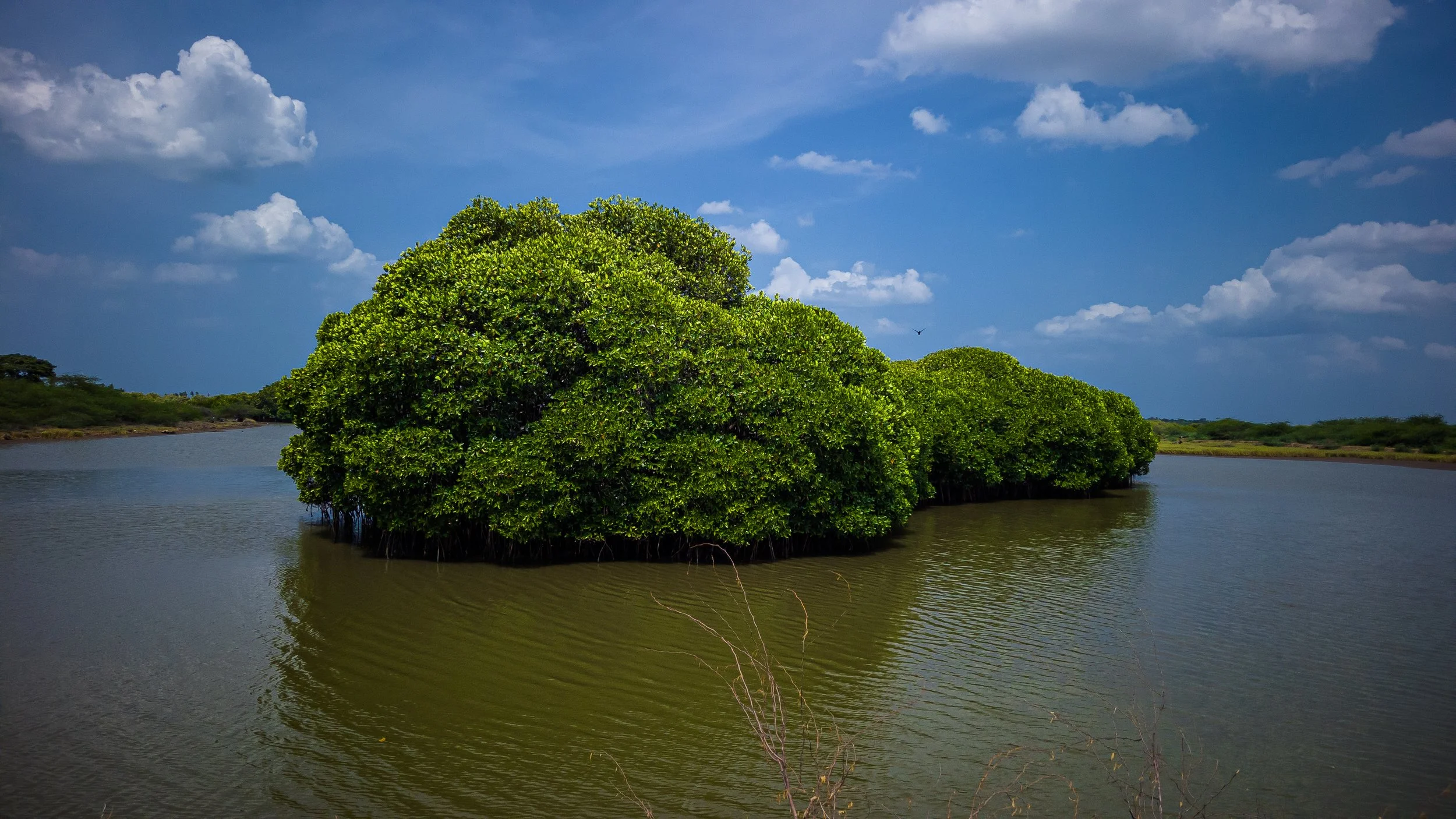
A beautiful mangrove sight!
Birds moved gracefully across the wetlands.
The salty air carried the scent of mud, water and vegetation.
We stood there for several minutes without speaking. Sometimes travel doesn't need commentary.
Presence is enough.
Eventually, reality returned. The clock read 2:15 PM.
We smiled at each other. "Time to go."
Back into the car and back onto the narrow road. A couple more muddy stretches.
One final right turn.
And then, just as I remembered from the photograph the organisers had shared...
A familiar entrance gate appeared.
Google Maps had done its job. My memory had done its part.
And together, they led us safely to MangroveBay Eco Camp.
As I drove through the entrance, neither of us knew it yet.
But one of the most memorable weekends of our lives had just begun.
Where Curiosity Became the Destination
The moment we entered the campsite, both of us instinctively slowed down.
Perhaps it was the stillness.
Perhaps it was the beauty of the place.
Or perhaps our minds simply needed a few moments to realise that we had actually arrived.
A simple dining hall beneath the trees and rows of camping tents stood neatly overlooking the water. Beyond them stretched the calm backwaters, slowly disappearing into a dense green wall of mangroves. The breeze carried the unmistakable scent of brackish water mixed with wet earth.
It was peaceful.
Not the kind of peace that comes from silence. The kind that comes from nature quietly going about its own business.
I looked at my son. He looked back at me.
Neither of us said anything.
We simply smiled. Sometimes excitement doesn't need words.
The Best Way to Know a Place Is to Walk It
After parking the car, we completed the registration formalities and kept our bags aside. The programme hadn't started yet. So instead of sitting and waiting, we did what we almost always do whenever we visit a new place.
We wandered.
No destination.
No hurry.
No checklist.
Just curiosity.
Travel, I have realised over the years, becomes richer when you allow yourself to become a little child again.
Children don't rush towards the "main attraction."
Everything is the attraction.
The pathway.
The insects.
The flowers.
The sound of birds.
The smell after rain.
The little things adults often walk past without noticing.
We slowly made our way towards the shoreline.
The mangroves looked magnificent from up close.
Their exposed roots rose from the muddy banks like hundreds of sculptures patiently shaped by nature over centuries.
Tiny crabs scurried sideways into their burrows the moment they noticed us.
A few mole crabs disappeared almost magically into the wet sand.
My son immediately crouched down to observe them. "So fast!", he laughed.
Nature has an amazing ability to make even the smallest creatures feel extraordinary.
Footprints That Told a Story
As we continued walking, something unusual caught our attention. A series of footprints pressed gently into the soft mud. Neither of us recognised them immediately.
They weren't bird tracks.
They weren't human.
They looked... different.
We bent down, trying to guess.
A little later, we came to know that "Those are Smooth-coated Otter footprints."
Suddenly, those simple impressions in the mud became far more exciting.
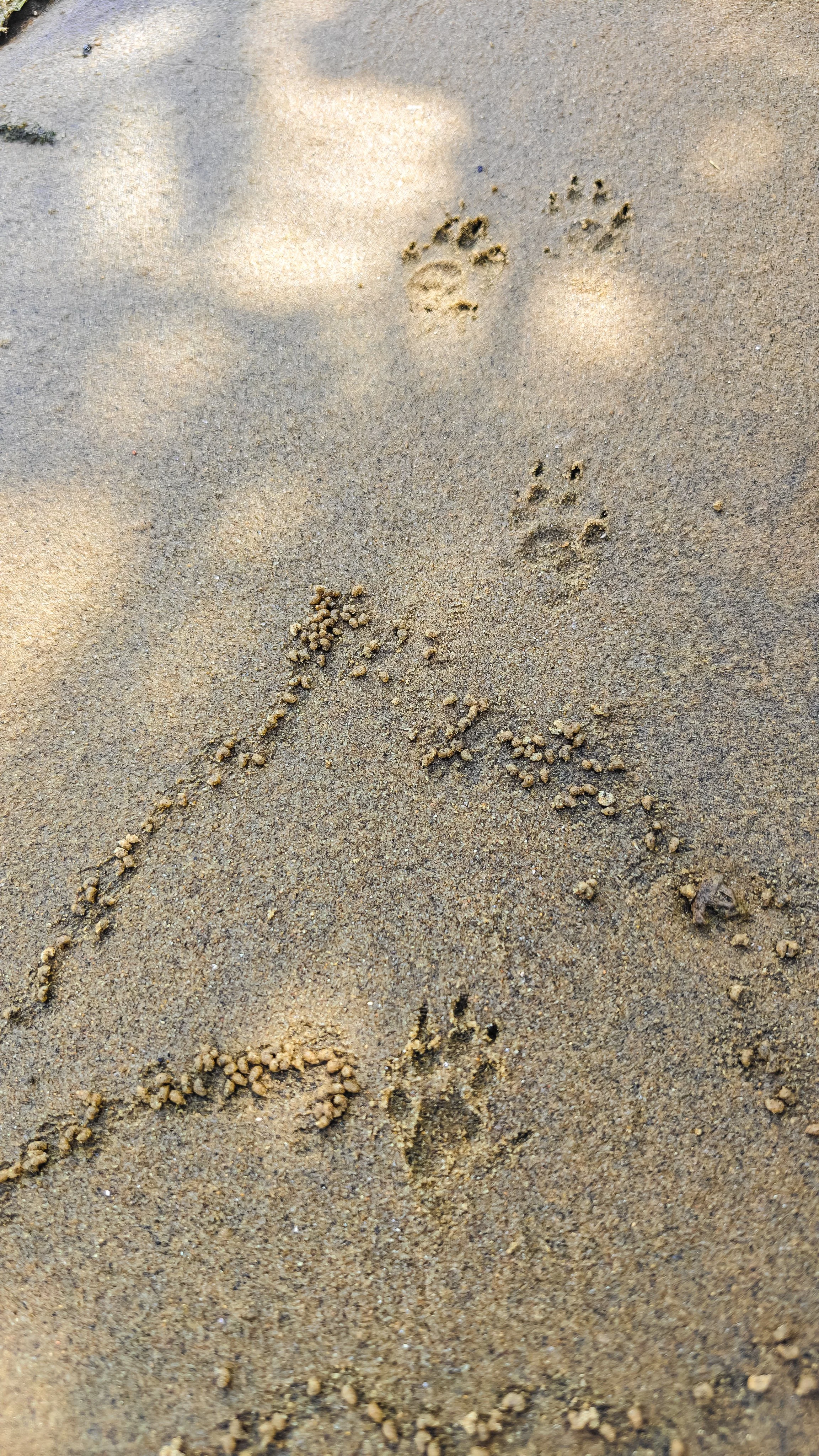
The Otter Footprints
We never actually saw the otters.
But somehow, knowing they had wandered through the same shoreline only hours earlier made us feel connected to the place.
It reminded me of something beautiful about nature.
Not every encounter requires seeing the animal.
Sometimes... following its story is enough.
A Hut Filled With Curious Minds
Slowly, participants began gathering inside a beautifully simple meeting hut overlooking the water.
My son and I joined them.
One by one, everyone introduced themselves. Within minutes, conversations flowed naturally.
There was no awkwardness. No hesitation.
Only curiosity.
That is one thing I have always admired about communities built around learning.
When curiosity becomes the common language, strangers become friends much faster.
Soon, Bhavanandhi, the founder of Starvoirs, joined us.
If enthusiasm could take human form, it would probably look like Bhavanandhi. He greeted everyone warmly, cracked a few jokes, and almost instantly transformed the atmosphere.
It no longer felt like participants attending an organised event.
It felt like old friends gathering after a long time apart.
We spoke about where we had travelled from.
What fascinated us.
Why we loved astronomy.
Why history mattered.
Even before the formal session began, learning had already started.
Then History Walked Into the Room
A few moments later...
Anirudh Kanisetti arrived.
There was no dramatic announcement. No grand introduction. Just a warm smile and a humble greeting.
Yet the energy inside the room changed immediately. For the next couple of hours, the mangroves outside almost disappeared from our attention.
Because our minds had travelled nearly a thousand years into the past.
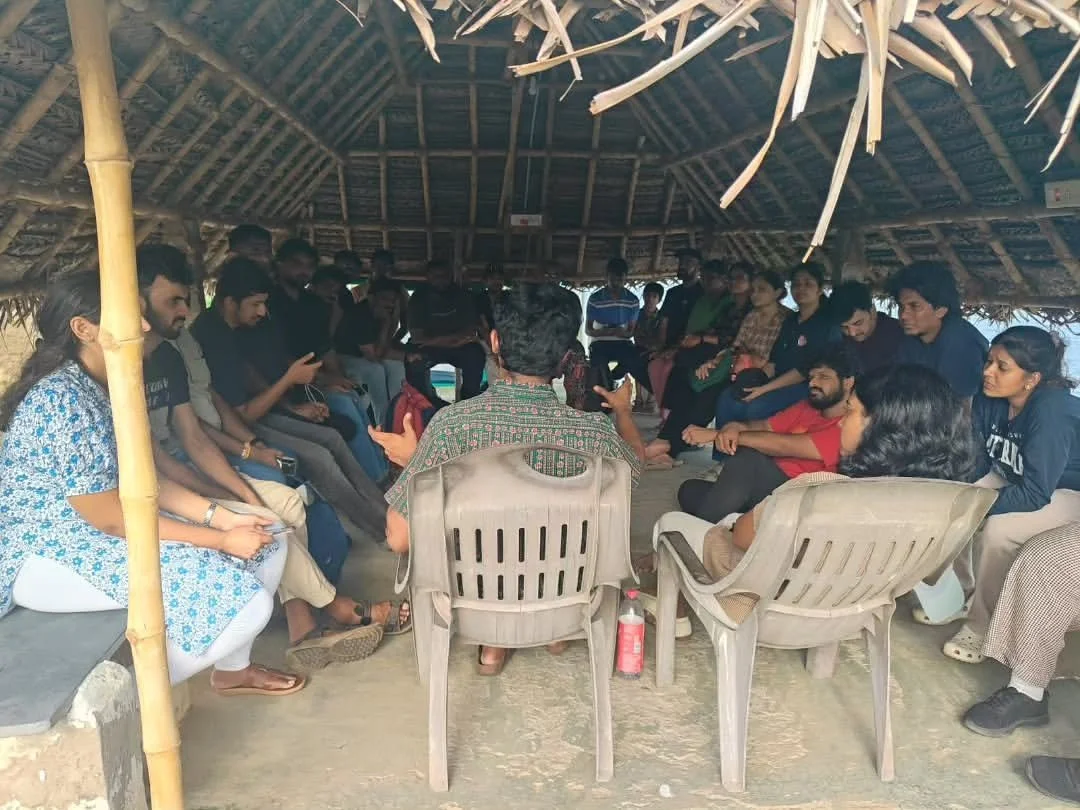
Conversation with Anirudh Kanisetti
The Chozhas Were Never Just Kings
Like many of us, I had learnt about the Chozhas in school.
Kings – Temples – Battles – Dates – Dynasties
Useful information for examinations.
But history often loses its soul when it is reduced to memorising facts.
Anirudh didn't speak about dates.
He spoke about people.
About ambition.
About exploration.
About trade.
About evidence.
Most importantly... about asking questions.
He explained how historians don't simply accept stories because they sound convincing.
They verify.
They compare inscriptions.
They study archaeological discoveries.
They examine foreign records.
They read ancient literature.
They challenge existing assumptions.
History, he reminded us, is less about believing and more about investigating.
As someone who constantly encourages people to verify information rather than blindly accepting what they hear on social media, I found that deeply meaningful.
In many ways...
Good history and good science follow the same philosophy.
Evidence first.
Opinion later.
Oceans Without GPS
One discussion fascinated me more than anything else.
The Chozhas were not merely powerful rulers. They were remarkable navigators. Their ships crossed the Bay of Bengal and established trade networks stretching across Sri Lanka, Southeast Asia and beyond. Naturally, someone asked the question all of us were thinking.
"How did they navigate such enormous distances without GPS?", the discussion that followed was fascinating.
Long before electronic navigation...
Long before satellites...
Long before digital charts...
Sailors looked upwards. The stars became their compass. The Sun helped determine direction during the day. The night sky became a map after sunset. Knowledge of seasonal winds, ocean currents and celestial movements passed carefully from one generation to another.
Listening to this while sitting beside the mangroves felt strangely powerful. Only a few hours later, we ourselves would paddle through these waters.
Our journey would last only a couple of hours.
Theirs lasted weeks.
Sometimes months.
Yet they trusted the same sky we would soon be observing through telescopes.
History suddenly stopped feeling distant.
It became personal.
Questions Without Ego
What impressed me even more than Anirudh's knowledge was his patience.
Questions came from every direction.
Some were about archaeology.
Some challenged common historical narratives.
Some explored maritime trade.
Others discussed literature and inscriptions.
Not once did he dismiss a question.
Not once did he make anyone feel uncomfortable for asking.
Instead, he answered thoughtfully.
Occasionally with humour.
Frequently with evidence.
Always with respect.
I left that session thinking something far beyond history.
Knowledge becomes truly valuable only when it is shared with humility.
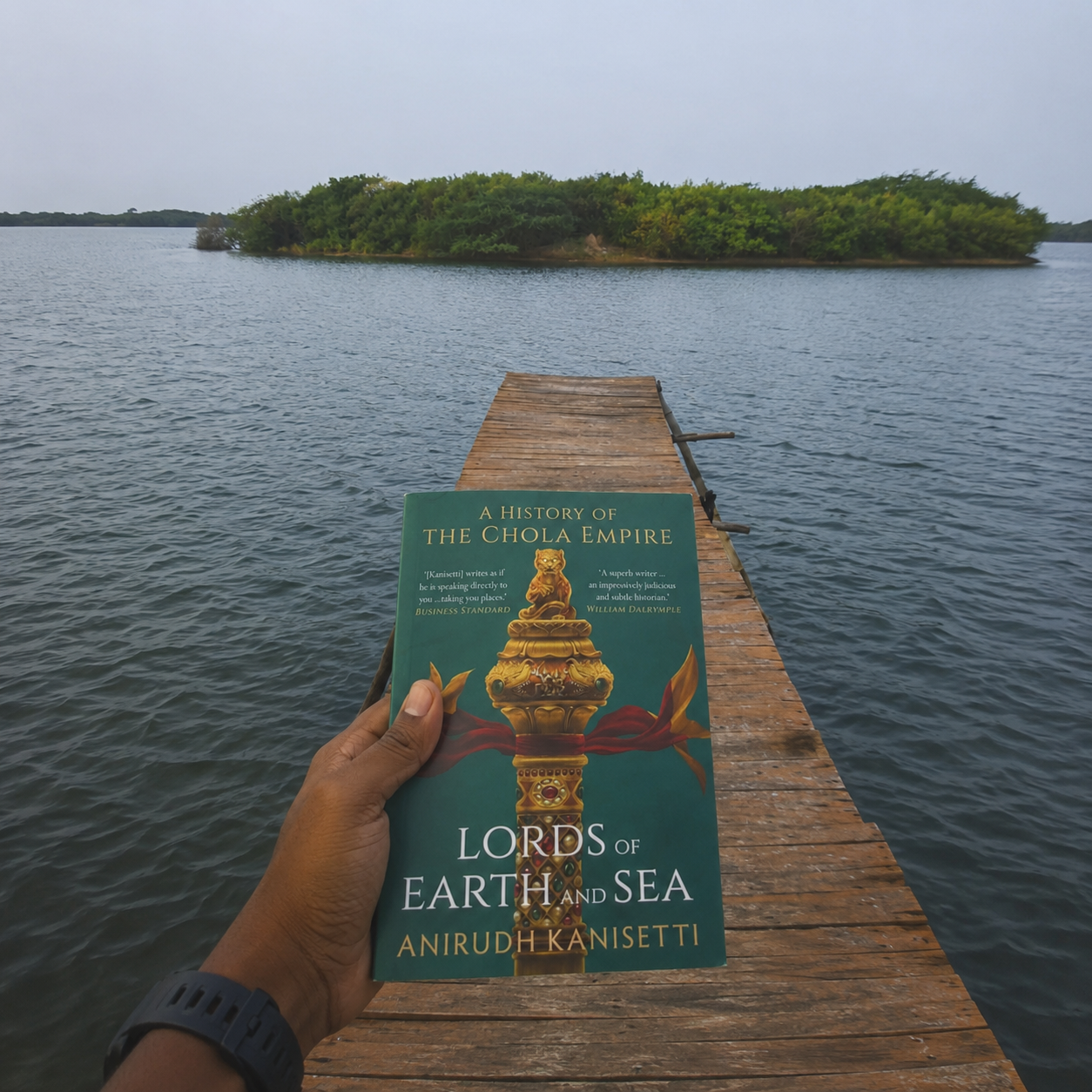
Time to Meet the Mangroves
As the discussion ended, the room filled with a completely different kind of excitement.
The historians became adventurers. The listeners became paddlers.
The organisers announced that it was time to prepare for kayaking. Everyone was given a short break to freshen up and change into comfortable clothes.
Participants would be divided into two groups. One group would experience the mangroves at sunrise. The other, during sunset.
Since the next morning was my son's birthday, we wanted to begin the day early and continue our celebrations with family.
So I requested Bhavanandhi if we could join the sunset batch. Without hesitation, he smiled, "Absolutely."
Within minutes, we had changed, tightened our life jackets, picked up our paddles and walked eagerly towards the water.
Standing there, looking at the line of colourful kayaks waiting quietly beside the mangroves, my son looked at me with the same excitement he had shown when we first entered the campsite.
Neither of us knew then that the next two hours would teach us lessons far beyond kayaking.
They would teach us about rhythm. Communication. Patience. Curiosity.
And, without either of us realising it, a little about parenting too.
Beneath the Mangroves, Beneath the Stars
The evening sun had begun its slow descent, casting a warm golden glow across the backwaters.
The mangroves, which had looked lush green only an hour earlier, now reflected shades of amber and gold. Gentle ripples danced across the water as the kayaks waited patiently along the shoreline.
For a brief moment, none of us rushed.
Everyone stood there looking at the water.
Some were quietly taking photographs.
Some were adjusting their life jackets.
Others were already imagining themselves gliding through the mangroves.
My son and I simply stood there smiling.
The excitement of trying something new never really disappears with age.
Adults simply become better at hiding it.
A Kayak Is a Wonderful Teacher
The instructors assigned us a tandem kayak.
Immediately, we walked towards it - not because we had to, but because curiosity naturally pulled us closer. Like children examining a new toy, we inspected everything.
The seats, the footrests, the paddles, and the shape of the kayak.
Somewhere in our minds, we had already imagined ourselves paddling gracefully through the mangroves.
The instructor, meanwhile, had a more practical plan. First came safety. Patiently, he explained how to hold the paddle correctly.
How to paddle forward.
How to reverse.
How to turn.
How to stop.
How to help your partner rather than unknowingly working against them.
Listening to him, I realised something. Adventure sports rarely teach only the sport. They quietly teach life.
Without classrooms.
Without PowerPoint slides.
Without examinations.
Only through experience.
Finally, the moment arrived. The instructor signalled us to board. Before I could say anything, my son turned towards me.
"Appa... I'll sit in the front."
I smiled immediately and said "Thambi... nee front-la thaan." ("Of course, little brother... the front belongs to you.")
He probably thought I was merely assigning him a seat. But inside my mind, that moment carried a much deeper meaning. Children should always have the front-row view of life.
As parents, perhaps our role is not always to stand ahead and lead every journey.
Sometimes our responsibility is to sit quietly behind them.
Helping when needed and correcting course gently. Allowing them to believe they are discovering the world on their own.
He settled comfortably into the front seat. I took the rear. Looking back now, I cannot imagine us sitting any other way.
Finding Our Rhythm
Following the instructor's guidance, we gently pushed away from the shore. The kayak rocked ever so slightly.
For a few moments, every movement felt exaggerated.
The instructors asked everyone to remain close until all participants had safely entered the water.
Those waiting minutes became our first lesson.
Forward.
Backward.
Turn left.
Turn right.
Simple instructions.
Sometimes I paddled while he paused. Sometimes he paddled while I corrected the direction. Occasionally, both of us paddled enthusiastically, but also in completely different rhythms.
The kayak responded with admirable honesty.
"Gentlemen... perhaps you should first decide where you wish to go."
We burst into laughter. Then I suggested something.
"Let's call out every stroke."
"Left!"
"Right!"
"Left!"
"Right!"
Almost immediately, everything changed.
The kayak stopped arguing with us.
Instead of two people paddling independently, we slowly became one team.
Communication, I realised once again, often solves problems long before strength does.
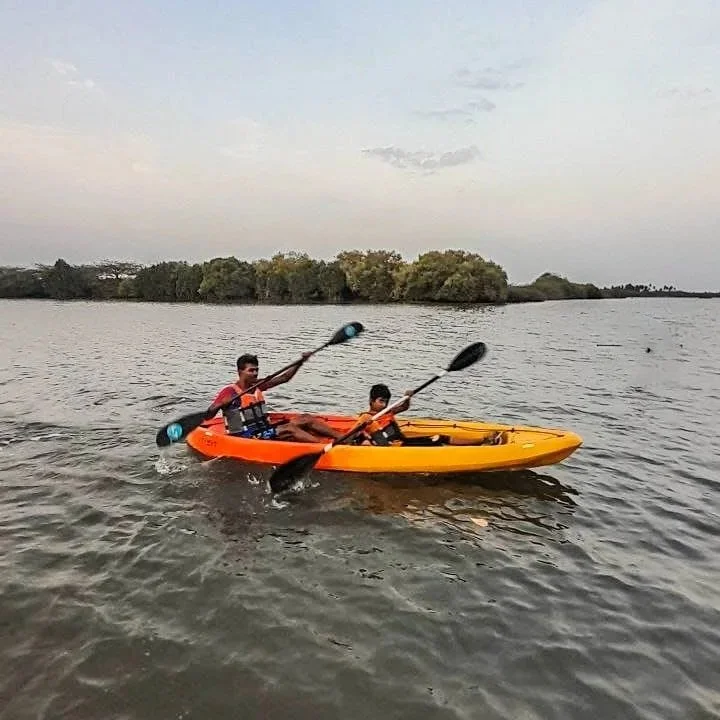
Kayak with my son
Into the Living Forest
Soon, every kayak had entered the water.
Our instructor began leading the group through the mangrove channels.
The campsite slowly disappeared behind us.
The sounds of people faded.
Now there was only the gentle splash of paddles entering water.
Bird calls echoed across the wetlands.
The occasional breeze rustled through the mangrove leaves.
And everywhere around us...
Life.
The mangroves felt alive.
Their aerial roots rose dramatically from the muddy water like thousands of patient guardians protecting the coastline. It was impossible not to admire how perfectly everything belonged together.
Nature doesn't compete. It collaborates.
The Shortcut Everyone Wanted
One of the younger instructors, confidently balancing on a Stand-Up Paddleboard (SUP), called out to the group.
"If anyone wants to explore inside the mangroves, follow me!"
That was enough.
Immediately, several participants enthusiastically steered their kayaks towards a narrow opening in the vegetation. It reminded me of children hearing someone whisper, "There's a secret passage..."
Everyone suddenly becomes an explorer.
My son looked at me, "We'll go too?"
"Of course."
But there was no need to rush. The mangroves had waited for centuries. They would happily wait another minute for us.
Chennai Traffic... Inside the Mangroves
As we slowly entered the narrow channel, the atmosphere changed completely. The waterway narrowed. Branches leaned over us. The world outside disappeared. It felt less like kayaking and more like floating through a green tunnel.
Then...
Everything stopped.
Ahead of us stood complete confusion. Kayaks pointed in every imaginable direction.
Some sideways.
Some backwards.
Some attempting elegant turns that ended with gentle collisions.
Nobody seemed particularly worried.
Everyone was laughing.
For one glorious moment, the mangrove forest had successfully recreated Chennai traffic.
The only difference?
Nobody was honking. Eventually we understood the problem. The first few kayaks had enthusiastically paddled all the way inside, only to discover that the channel ended abruptly. Now everyone was trying to turn around simultaneously in a space barely wide enough for a single kayak.
The result was magnificent chaos.
Curiosity Deserves Completion
Many participants decided to remain where they were. Some waited outside until the congestion cleared.
My son and I exchanged a glance, "We've already come this far."
"Let's go all the way."
Not because someone had promised us a hidden treasure. Not because there was supposedly something spectacular waiting at the end. Simply because curiosity deserves completion.
Eventually, the floating traffic jam cleared. We quietly paddled deeper.
The mangroves became denser.
The light dimmed.
The silence grew stronger.
We reached the very end.
There was nothing extraordinary.
No hidden waterfall.
No secret island.
No mysterious discovery.
Just still water and dense mangroves. But calm and silent.
Yet somehow, it felt perfect.
Sometimes life is exactly like that.
People often tell us,
"There's nothing there."
But perhaps the value isn't in what we find. Perhaps the value lies in discovering it ourselves. We gently turned our kayak around and rejoined the group. Several participants who had waited outside smiled as we emerged.
My son grinned.
So did I.
The detour had been worth it.
The Sweetest Sundal I've Ever Eaten
Time behaves strangely during adventures.
Two hours disappeared without either of us noticing.
Not once did either of us ask,
"When are we going back?"
That, perhaps, says everything.
Back at the campsite, steaming cups of tea and bowls of warm sundal awaited us. I have eaten sundal countless times in my life. But after two hours of paddling through mangroves, that humble bowl tasted extraordinary.
Perhaps hunger is the finest chef. Or perhaps shared adventures season food in ways no recipe ever can. We refreshed ourselves, changed into comfortable clothes and gathered once again.
Only this time...
Our classroom had shifted from the river to the universe.
When History Returned Through the Stars
Darkness settled gently across the mangroves. The first stars appeared one after another. Away from city lights, the night sky slowly unfolded its brilliance.
Bhavanandhi invited us to gather around the telescope. What followed wasn't merely a stargazing session. It was storytelling through the universe. One by one, he introduced us to the celestial landmarks above us.
We admired Vega, shining brilliantly in the summer sky.
We found Antares, glowing with its beautiful reddish hue at the heart of Scorpius.
Looking lower towards the southern horizon, we observed Alpha Centauri, our Sun's nearest stellar neighbour - a reminder that even our closest stellar neighbours lie unimaginably far away.
He explained that many stars appearing as a single point of light are actually double-star systems or members of larger stellar families, quietly orbiting one another over millions and billions of years.
The universe, he reminded us, is often far more complex than what our eyes first perceive. Standing there beneath that magnificent sky, my thoughts drifted back to the afternoon. Only a few hours earlier, Anirudh Kanisetti had spoken about Chozha sailors navigating vast oceans.
Now, I found myself looking at the very sky that had once guided them.
No GPS.
No satellites.
No electronic charts.
Only stars.
Those same celestial patterns had once helped courageous mariners cross the Bay of Bengal in search of trade, diplomacy and discovery.
In that moment, history no longer belonged to museums or textbooks. It stretched above our heads.
Alive – Ancient - Unchanged.
And we stood beneath it with wonder.
Some Birthdays Are Lived
The universe could wait. For now, it was dinner time.
The moment Bhavanandhi announced a short break, my son and I instinctively looked at each other.
Without saying a word, we started walking towards the dining hall.
Or, as we jokingly say in Tamil...
"பந்திக்கு முந்து!" 😄(The first ones to reach the feast!)
I don't know whether it was the kayaking or the excitement of the evening, but somehow we managed to become the very first people to enter the dining area.
Meanwhile, outside, several participants were still passionately discussing stars, constellations and everything Bhavanandhi had explained.
Looking back at them, I laughed. "Come fast! The food won't orbit around you forever!"
A few laughed. A few replied, "Just two more minutes!"
Somehow, astronomers always seem capable of postponing dinner if the conversation is interesting enough.
Eventually everyone gathered around the dining tables.
The food was simple.
Fresh.
Homely.
Exactly the kind of meal that tastes extraordinary after spending two hours paddling through mangroves.
Then came my favourite surprise.
A glass of thengai paal.
Sweet.
Refreshing.
Perfect.
Sometimes luxury isn't found in expensive food.
It is found in simple food served after an unforgettable day.
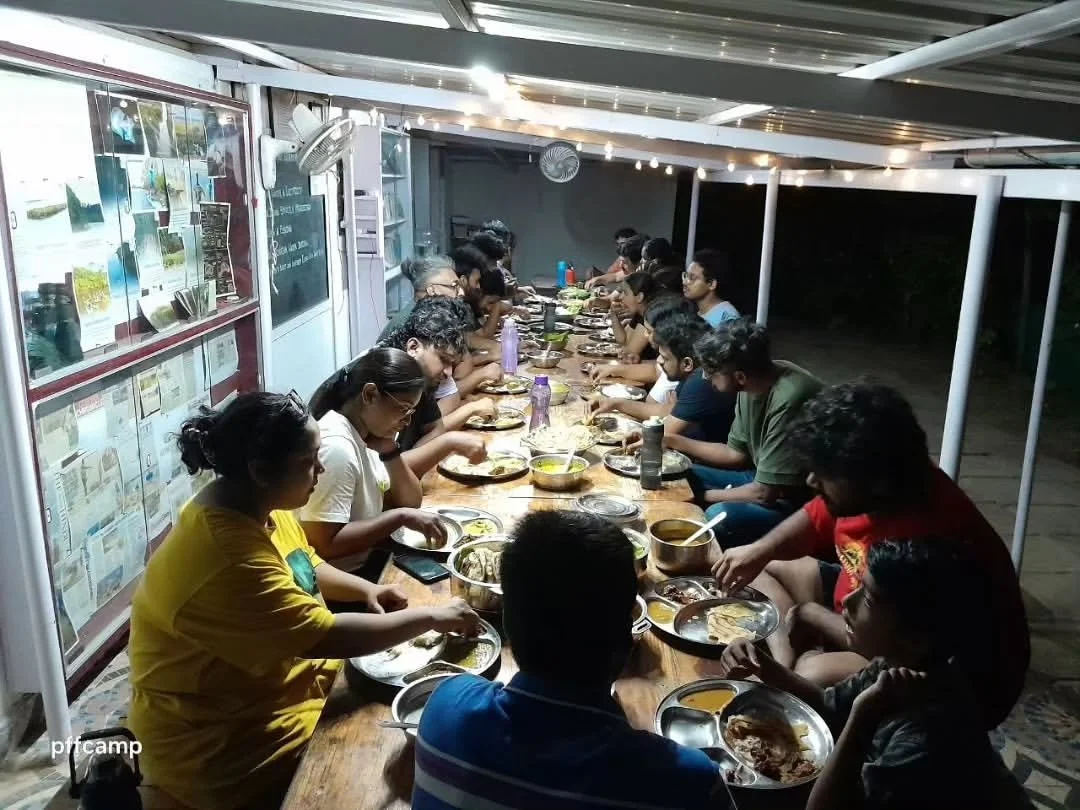
A wonderful dinner time
A Birthday I Had Quietly Planned
A few days before the trip, I had spoken privately with Bhavanandhi.
"My son's birthday is tomorrow."
"If possible..."
"I have one small request."
"Could we celebrate it here with everyone?"
Without even thinking twice, he responded to me, "Absolutely."
That simple response meant more to me than he probably realised. Because I wasn't looking for a grand celebration. There were no elaborate decorations.
No giant balloons.
No expensive party hall.
No loud music.
In fact...
That was exactly the point.
I wanted my son to experience something very different. To celebrate his birthday among people he had known for less than a day.
People who had arrived as strangers. Yet somehow already felt like friends. Communities built around curiosity have a beautiful quality. They erase the invisible walls we usually build around ourselves. I have always believed that children shouldn't grow up believing kindness exists only within family and close friends.
They should experience that kindness can also come from complete strangers.
Because today's stranger may become tomorrow's mentor.
A lifelong friend.
Or simply a beautiful memory.
The Cake Arrives
After everyone had finished dinner, we requested them to remain seated for another five minutes.
The cake had been slightly delayed.
Those five minutes probably felt longer to me than they did to anyone else.
Then...
Someone rushed in carrying the cake. My son noticed it immediately.
He looked at the cake.
Then looked at me.
Then at Bhavanandhi.
A smile slowly spread across his face.
The kind of smile that doesn't need photographs to be remembered.
Everyone gathered around.
The birthday song echoed through the quiet campsite.
There we were...
In the middle of the mangroves.
Under an open sky.
Surrounded by people we had met only that afternoon.
And yet...
It felt strangely like family.
My son cut the cake.
Everyone cheered.
Some wished him in Tamil.
Some in English.
Some simply shook his hand warmly.
Afterwards, both of us carried the cake around, happily serving every participant ourselves.
Watching him thank everyone in his way made me quietly proud. As parents, we often spend years teaching children to say, "thank you."
Moments like these show us whether they have truly learnt it. As I watched him laughing and speaking with everyone, one thought quietly entered my mind.
Years from now...
He probably won't remember the flavour of that cake.
But I hope he remembers the feeling.
Because feelings stay.
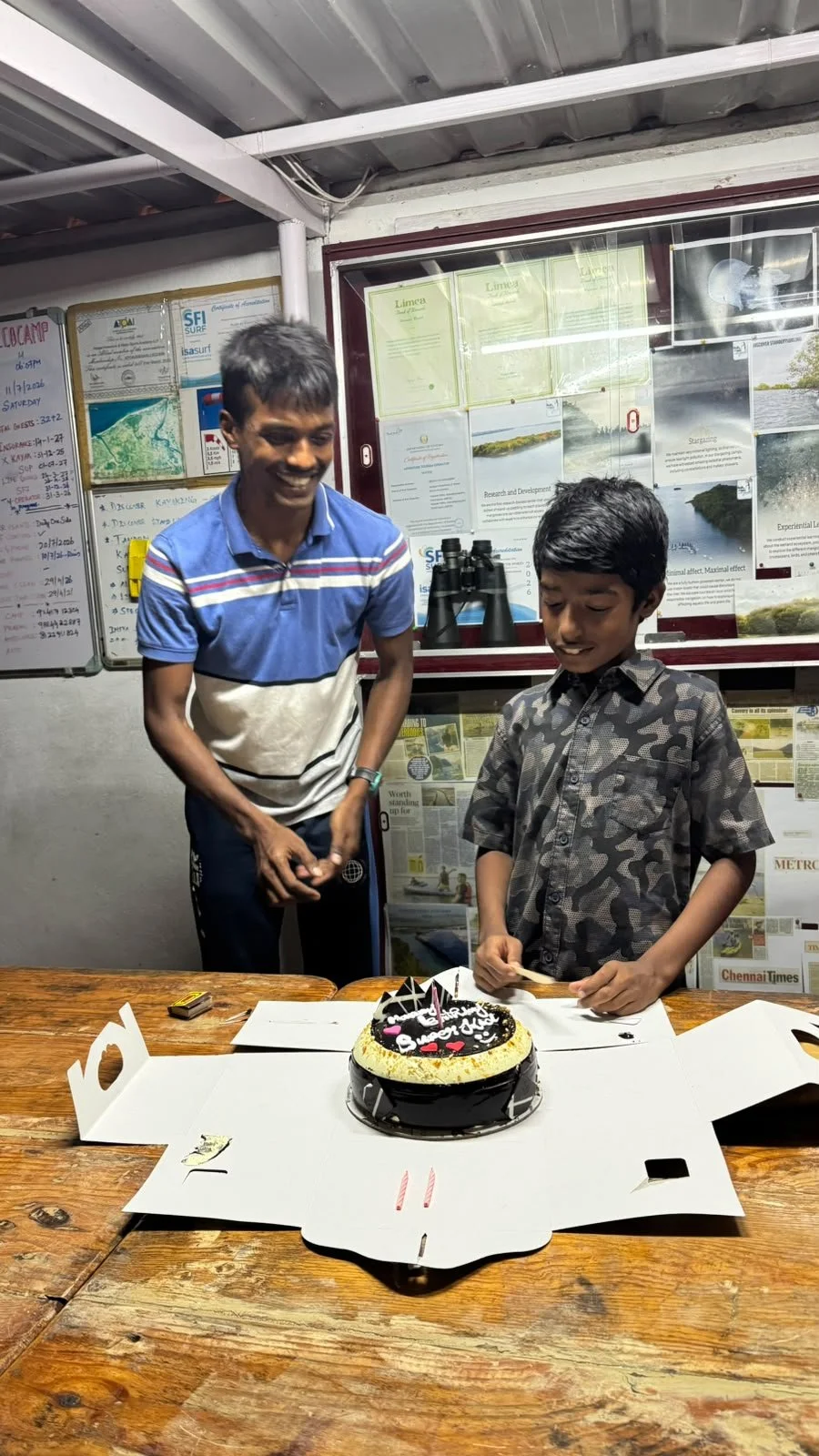
Back to the Universe
Soon after the celebration, everyone prepared to return to the stargazing session.
I had already informed Bhavanandhi that we would be leaving early the next morning to continue the birthday celebrations with family at my wife's native place.
My son, by now, was visibly tired.
And honestly, I didn't blame him.
Within a single day he had driven across Tamil Nadu.
Explored mangroves.
Learnt about the Chozhas.
Kayaked for two hours.
Observed the stars.
Celebrated his birthday.
That is enough adventure for any ten-year-old.
Around 10:15 PM, I took him back to our tent.
Within minutes...
He was asleep.
Watching children sleep after a day spent entirely outdoors is strangely satisfying.
It silently tells you...
Today was lived well.
I quietly returned to join the rest of the group.
The conversations had become softer now.
People spoke in lower voices.
Occasionally someone would gasp while looking through the telescope. The stars seemed brighter than before. Or perhaps our eyes had simply become more patient. Time slipped away unnoticed. By the time I returned to the tent...
It was already around 11:30 PM.
Camping, of course, comes with its own little adventures. The tent felt slightly warm. There wasn't much airflow. For a few moments I lay there smiling.
Hotels give us comfort.
Camping gives us stories.
I partially opened the entrance to let the cool breeze flow through. Within minutes, sleep found both of us.
The Morning Gift
At around 5:30 AM, I heard Bhavanandhi's familiar voice outside.
"Anyone awake? Come and see the Moon!"
That invitation was impossible to ignore.
I stepped outside.
The campsite was wonderfully quiet.
The morning breeze carried the freshness that only wetlands seem capable of creating.
Through the telescope, the Moon appeared astonishingly detailed.
Its craters.
Its shadows.
Its rugged mountains.
It felt less like looking at the Moon...
And more like looking at another world.
I stood there for several minutes. Completely silent. Astronomy has a beautiful way of making our daily worries feel wonderfully small.
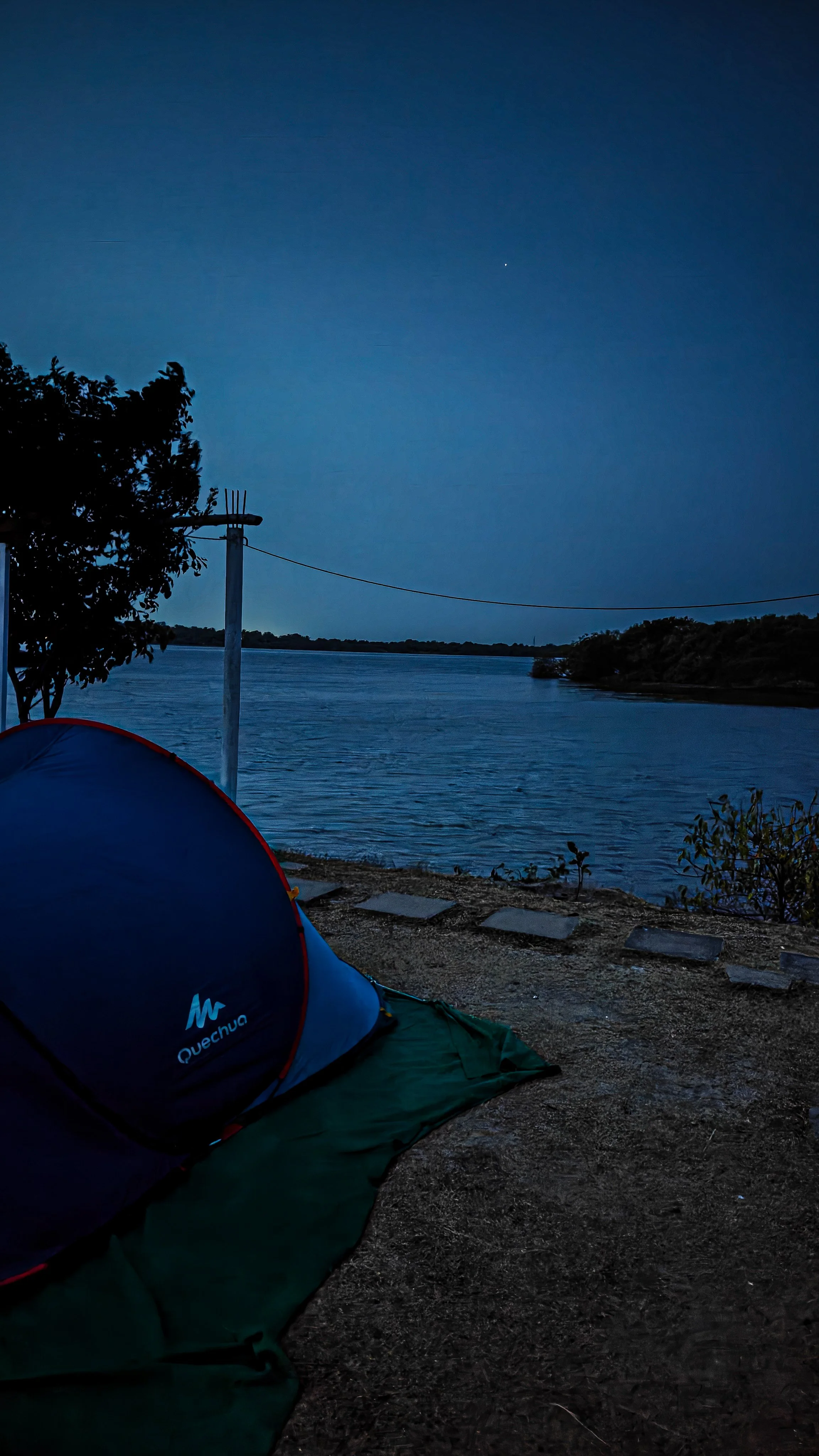
A beautiful view of tent, backwaters and the sky
Goodbye... For Now
After freshening up, I gently woke my son. We packed our bags. Had a hot cup of tea. Walked around the campsite one final time. Then came the part every beautiful journey eventually reaches.
Goodbyes.
We thanked Bhavanandhi, the incredible Starvoirs.
The lovely author Anirudh Kanisetti and his spouse.
The wonderful staff of MangroveBay Eco Camp.
And every participant who had unknowingly become part of one very special birthday.
Our bags found their way back into our faithful Tata Nexon.
One last photograph.
One last wave.
One last look at the mangroves.
Then...
The engine started.
Our next destination awaited.
My wife's native place. Where another birthday celebration would continue.
The Conversations That Matter Most
As we drove away, something beautiful happened.
Neither of us reached for a mobile phone.
Instead...
We talked.
About kayaking.
About history.
About overtaking safely on narrow roads.
About mangroves.
About the birds.
About the Moon.
About the stars.
About the Chozhas.
About where we should travel next.
And while listening to him speak with such excitement, I quietly smiled.
This...
This is why I keep taking my children on journeys like these.
Children don't remember every gift they receive.
But they remember how a place made them feel.
They remember the excitement of trying something for the first time.
They remember the people who were kind to them.
They remember the stories shared around dinner.
They remember the silence beneath a sky full of stars.
Most importantly...
They remember the conversations that happened along the way.
Beyond the Paddle
When I first planned this trip, I thought I was taking my son kayaking.
Looking back now, Kayaking became only a small part of the story. We travelled through the waterways of the Chozha region. Learnt how history is built on evidence rather than assumptions. Discovered that the same stars we admired once guided sailors across vast oceans.
Celebrated a birthday among people who reminded us that kindness requires no introduction. And somewhere between paddling, laughing, listening and looking up at the night sky I realised something.
Perhaps the greatest gift we can give our children isn't another possession.
It is perspective.
Perspective that the world is bigger than our neighbourhood.
That history is more fascinating than memorising dates.
That science becomes magical when experienced.
That strangers can become friends.
That nature is the greatest classroom ever built.
And that curiosity is one of the finest qualities a child can carry into adulthood.
Years from now, my son may not remember the exact taste of the birthday cake.
He may not remember how many kilometres we drove.
Or the model of the kayak we paddled.
But I hope he remembers standing beneath an ancient sky...
Listening to stories of the Chozhas...
Paddling through quiet mangroves...
Laughing at a traffic jam on water...
And discovering that the world is far more beautiful than any screen could ever show.
Because some birthdays are celebrated.
The best ones are lived.
A Note of Gratitude
My heartfelt thanks to Bhavanandhi, the wonderful Starvoirs team, the staff at MangroveBay Eco Camp, fellow participants, and Anirudh Kanisetti for creating an experience that seamlessly brought together history, astronomy, ecology, adventure and human connection.
You all created memories that a father and son will carry for a lifetime.