The Courage to Ask Questions in an Age of Noise
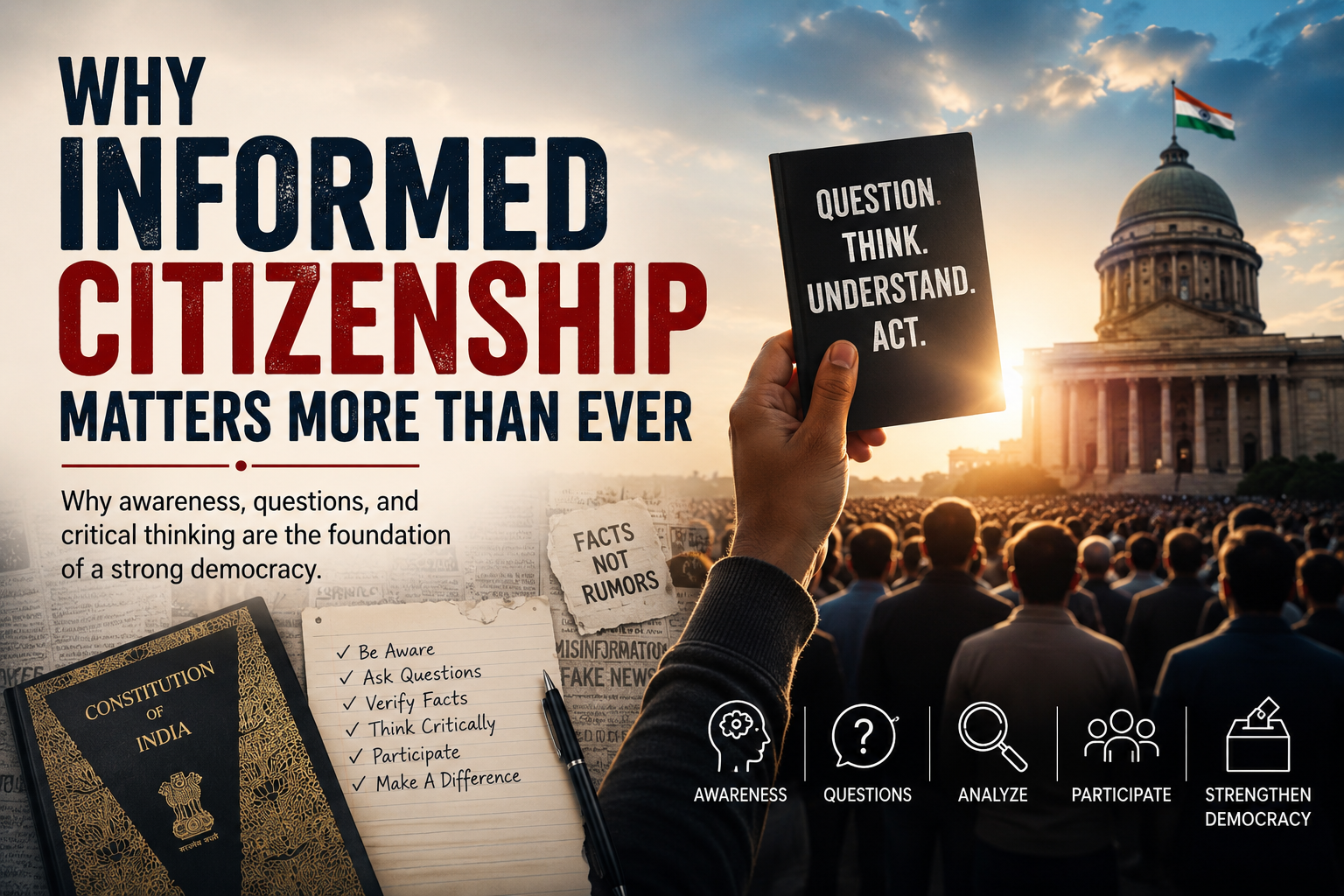
Why Informed Citizenship Matters More Than Ever
Why I keep talking about awareness, questions, democracy, and the responsibility of citizenship.
Reading Time: 8–10 minutes
In This Article
- Why I Started Asking Questions
- Lessons from Service and Public Life
- When Questioning Became Uncomfortable
- Awareness Is Protection
- The Rise of Political Fandom
- Social Media and Critical Thinking
- Neuroscience, Confirmation Bias, and the Mind
- Tamil Nadu’s Political History of Awareness and Questions
- Why Citizen Awareness Matters
- The Project I’m Building
Over the last few months, a few friends have asked me a simple question:
“Why are you suddenly writing so much about politics, governance, constitutional rights, public policy, misinformation, and political awareness?”
Some assume I am becoming more political. Others assume I am supporting one side and opposing another.
The truth is much simpler.
I am not fascinated by politics. I am fascinated by people.
More specifically, I am fascinated by what happens to a society when people stop asking questions.
Why I Started Asking Questions
Some of my earliest memories of public life are not of political rallies or election campaigns. They are of writing letters.
As a student, whenever I saw something that did not make sense, I would write. Sometimes it was a complaint. Sometimes it was a suggestion. Sometimes it was appreciation.
I never believed governments should only be criticised. If they did something right, they deserved appreciation. If they ignored a problem, they deserved criticism.
Lessons from Service and Public Life
Over the years, that habit stayed with me. I continued asking questions. I filed complaints when necessary. I raised concerns about civic issues. I appreciated officials when they responded. I criticised them when they did not.
I still remember a conversation with a senior minister years ago. He did not tell me my questions were wrong. Instead, he told me something far more valuable:
That advice stayed with me because real understanding begins where slogans end.
As a Rashtrapati Scout, I was taught that citizenship is not a spectator activity. Service, preparedness, discipline, responsibility, and respect for constitutional values were not abstract concepts. They were expectations.
I was fortunate to receive recognition at different stages of that journey, from institutions such as ISRO, the National Disaster Response Force, Tamil Nadu Police, and most memorably, recognition from the then President of India, Dr. A.P.J. Abdul Kalam.
When Questioning Became Uncomfortable
As I grew older, I noticed something changing around me.
When I was younger, disagreements existed. Political arguments existed. Ideological differences existed. But most people still accepted one simple principle:
Today, I increasingly see a different culture emerging. A culture where questioning is treated as hostility. Where asking for evidence is seen as disloyalty. Where asking “Why?” immediately forces people into political camps.
That worries me. Not because of any particular party, but because of what it says about us as citizens.
Awareness Is Protection
My own life taught me why this matters.
A few years ago, I found myself fighting a completely fabricated legal case. It was emotionally exhausting. It consumed time, energy, and peace of mind.
There were moments of frustration. Moments of anger. Moments when the easier option would have been to simply give up.
But I did not.
I fought because I knew enough to ask questions. I knew enough to understand my rights. I knew enough to trust institutions and procedures.
Eventually, facts prevailed. The truth prevailed. And that experience taught me a lesson I will never forget:
Awareness is protection.
The Rise of Political Fandom
Today, we live in an age where information is everywhere. Every report, every court judgment, every government order, every policy document, and every piece of data is just a few clicks away.
And yet, we increasingly rely on short videos, edited clips, political influencers, party handles, and social media forwards to understand complex issues.
We mistake consumption for understanding. We mistake repetition for truth. We mistake confidence for expertise. And slowly, without realizing it, we stop verifying.
Support is healthy. Participation is healthy. Believing in an ideology is healthy. Blind loyalty is not.
Social Media and Critical Thinking
Social media has accelerated this problem.
Algorithms are not designed to create informed citizens. They are designed to maximize engagement.
Outrage spreads faster than evidence.
Certainty spreads faster than curiosity.
The result is a society where people increasingly consume information that confirms what they already believe.
We are more connected than ever, yet often more divided than ever.
Neuroscience, Confirmation Bias, and the Mind
There is also a deeper human reason why misinformation spreads so easily.
Human beings are naturally drawn to information that confirms what they already believe. Psychologists call this confirmation bias. Neuroscience also suggests that once an idea becomes connected to identity, the mind does not always treat disagreement as new information. It can treat it as a threat.
That is why political arguments often become emotional so quickly.
People are not always defending facts. Many times, they are defending belonging, identity, memory, community, and the comfort of what they already believe.
If we do not understand how our own minds can be influenced, we become easier to manipulate.
Social media platforms amplify this tendency by rewarding emotionally charged content through likes, shares, comments, and engagement.
The result is a digital environment where outrage often travels faster than evidence.
Tamil Nadu’s Political History of Awareness and Questions
This is one reason Tamil Nadu’s political history continues to fascinate me.
Regardless of where one stands politically, one cannot ignore the role that public awareness, social questioning, political education, and civic participation played in shaping modern Tamil Nadu.
The state’s achievements did not emerge from blind obedience. They emerged from debate, from movements, from arguments, from people questioning existing structures, and from citizens who were willing to think beyond inherited identities.
From the Self-Respect Movement to the Hindi imposition agitations and debates on social justice, Tamil Nadu’s political culture was shaped by people who asked uncomfortable questions about dignity, language, equality, representation, and power.
That culture of questioning remains one of Tamil Nadu’s greatest strengths. And it is a strength worth protecting.
Why Citizen Awareness Matters
This is why I find myself returning to the same themes repeatedly.
- Data
- Evidence
- History
- Constitutional Literacy
- Media Literacy
- Critical Thinking
- Citizen Awareness
Some people ask why these topics matter. I would argue they matter more now than ever before.
Governments will come and go. Political parties will rise and fall. Leaders will emerge and disappear. But the quality of a society ultimately depends on the quality of its citizens.
The Project I’m Building
Perhaps that is why my recent writing has been moving in a different direction.
What began as occasional observations about governance, politics, public policy, misinformation, and citizenship has slowly evolved into something much larger.
I am now working on something bigger and more structured.
Not a book about a political party. Not a book about an election. Not a book about personalities.
But a project focused on citizenship itself.
A project that explores how ordinary people can better understand governance, verify information, interpret data, engage with public issues responsibly, understand constitutional rights, avoid manipulation, navigate political narratives, and participate meaningfully in democracy without becoming prisoners of ideology or personality cults.
They are built by informed citizens.
Citizens who read before they react.
Citizens who verify before they share.
Citizens who question before they believe.
Governments will come and go. Leaders will rise and fall.
But the future of a democracy will always depend on one thing:
whether it produces followers who obey or citizens who think.